Seasonal Guide
When to Fertilize Your Lawn in Central Indiana: A Month-by-Month Guide
By Speedway Lawn Maintenance, LLC 5 min read
The short answer
In central Indiana, fertilize cool-season lawns mainly in fall: early September, again in October, and a late-season feeding in early November while the grass is still green. Spring feeding should stay light, with mid to late May the better window, and most unirrigated lawns should skip fertilizer through the July and August heat.
If you are wondering when to fertilize a lawn in Indiana, the answer runs against habit: the most important feedings happen in September and November, not April. Central Indiana lawns are cool-season grasses, mainly Kentucky bluegrass, tall fescue and perennial ryegrass, and they do most of their root-building when nights cool off in fall. Feed them then and they come out of winter thick and early to green up.
Spring still has a role, but a smaller one than the garden-center displays suggest. Below is the month-by-month schedule we follow, the reasoning behind each step, and the few situations where we change it.
The Month-by-Month Schedule
These are typical windows for Marion County and the surrounding counties. Weather moves them a week or two either way, which is why we watch the forecast instead of the calendar.
| Month | Feed? | Why |
|---|---|---|
| January–February | No | Turf is dormant; product sits on frozen ground and can wash off |
| March | No | Roots are still cold; early nitrogen feeds top growth, not the plant |
| April | Optional, light | Usually paired with crabgrass pre-emergent; low nitrogen rate |
| May | Yes, moderate | Active growth; supports density heading into summer |
| June | Light, slow-release only | Helpful on irrigated lawns; skip on dry, stressed turf |
| July–August | Generally no | Heat and drought stress; fertilizer can burn or fuel disease |
| September | Yes, most important | Root growth, recovery from summer, pairs with overseeding |
| October | Yes | Builds density and carbohydrate reserves |
| November | Yes, late-season | After top growth stops but grass is still green |
| December | No | Too late for uptake |
Why Fall Carries the Program
Cool-season grass has two growth peaks, spring and fall, but they are not equal. In spring the plant is racing to produce leaves and seedheads. In fall, with soil still warm and air temperatures dropping, it shifts energy into roots, rhizomes and new tillers. Nitrogen applied in September goes straight into that thickening.
Purdue Turfgrass has long recommended putting the larger share of a lawn's annual nitrogen in fall, including a late-season application around early November, once mowing has mostly stopped but leaves are still green. That feeding does not produce a flush of growth. It gets stored and shows up as an earlier, more even green-up the following spring.
Spring: Lighter Than You Think
The instinct to fertilize heavily in March and April is understandable; the lawn looks tired. But a big dose of quick-release nitrogen in early spring pushes top growth the roots cannot support. You end up mowing more, the grass enters summer with shallow roots, and it browns faster in the first dry spell.
- If the lawn was fed properly last fall, April feeding can be skipped or kept very light.
- Mid to late May is the better spring feeding, once the lawn is actively growing.
- Crabgrass pre-emergent often goes down with a small amount of fertilizer as a carrier. That is fine; just do not stack another heavy feed on top of it.
Summer: When to Hold Back
July and August in Indianapolis bring heat, humidity and irregular rain. Unirrigated cool-season turf often goes semi-dormant, and pushing it with nitrogen does more harm than good. Heavy summer feeding can encourage brown patch and other diseases, and fast-release products can burn stressed grass.
Fine fescue, common in shady yards, is especially sensitive. Purdue advises against fertilizing it when temperatures are above 85°F. On well-irrigated bluegrass a light slow-release application in June can help, but most home lawns do better waiting for September.
Reading the Bag Before You Buy
The three numbers on a fertilizer bag are nitrogen, phosphorus and potassium. For established Indiana lawns, nitrogen is the one that drives the schedule. Purdue's guidance for most home lawns falls roughly in the range of 2–4 pounds of actual nitrogen per 1,000 square feet per year, split across several applications rather than dumped at once.
- Look for slow-release nitrogen, often listed as polymer-coated or stabilized. It feeds for weeks instead of days.
- Do not assume you need phosphorus. Many established lawns already have enough. A soil test tells you for certain; new seedings are the common exception.
- Sweep granules off drives and sidewalks back onto the turf so they do not wash into storm drains.
- Follow the label rate. More product is not more green; it is more runoff and more mowing.
Our lawn fertilization programs are built on this pattern, with a six-application season that shifts timing to the weather and adds targeted weed control where it is needed. Every application follows the product label and Indiana State Chemist (OISC) rules.
Local Adjustments Around Indianapolis
Heavy clay across Marion County holds nutrients well but drains slowly, so we avoid applying ahead of big storms that would carry product off the surface. Many older neighborhoods on our Indianapolis lawn care routes sit under mature shade trees, where turf needs less nitrogen and fescue benefits from lighter rates. Newer subdivisions on thin topsoil usually respond best to steady, moderate feedings rather than big single doses.
From our crew's experience
Timing Mistakes We See on Speedway Lawns
We schedule fertilizer by the seven-day forecast, not the date on a calendar. Granular product needs roughly a quarter inch of rain or irrigation within a day or two to move into the soil, but a storm that drops an inch or more on our clay just carries it down the driveway. Pete C. put it simply in his review: Cameron “keeps an eye on the weather and makes sure the treatments are done at the correct time.”
The mistakes we find most often on new-customer lawns around Speedway and the west side:
- Double-dosing in April. A weed-and-feed bag goes down, then a crabgrass product with its own fertilizer a week later. The lawn surges, then crashes in July.
- Feeding brown August turf. Dormant grass needs water, not nitrogen. Fertilizer on drought-stressed turf mostly feeds disease.
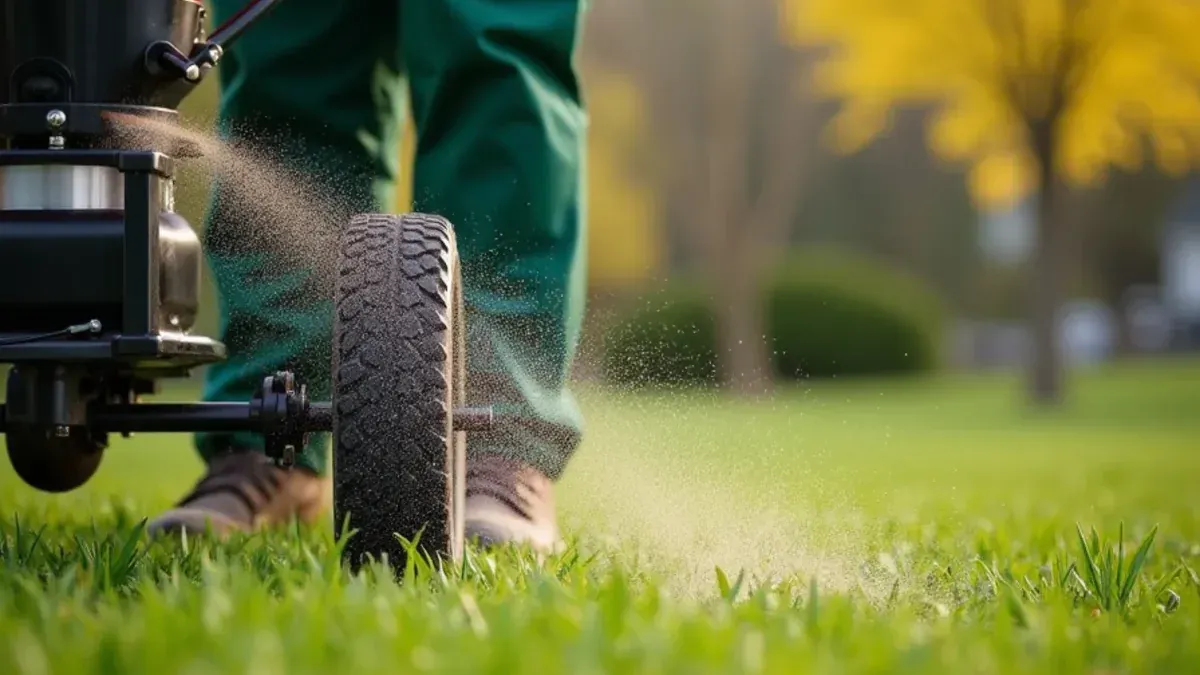
- Spreader striping. Dark green bands with yellow gaps mean the passes did not overlap to the wheel tracks.
- Seed and pre-emergent together. Most crabgrass pre-emergents also stop grass seed, so a spring seeding and a spring pre-emergent rarely share a lawn.
Two fall feedings with a decent broadcast spreader are a perfectly good DIY job. It is worth calling us when thin turf, weeds and fertilizer timing all need solving at once, or when you would rather not track the forecast yourself.
FAQ
Common Questions
Is it too late to fertilize my lawn in November in Indiana?
Not usually. Early to mid November is the classic late-season window for central Indiana. The grass has stopped growing much but is still green, so roots can take up nitrogen and store it. The cutoff is when the ground freezes or turf goes fully brown and dormant; after that, product mostly sits there and risks washing off.
Should I fertilize before or after rain?
Ideally just before a light rain, or water it in yourself with about a quarter to half inch. That moves granules off the leaf blades and into the soil. Avoid applying ahead of a heavy storm, especially on clay, because a downpour can carry fertilizer across hard surfaces and into drains before it soaks in.
How many times a year should an Indiana lawn be fertilized?
Most healthy cool-season lawns do well with three to five feedings a year, weighted toward fall. Professional programs often run six rounds, with some visits focused on weed control or pre-emergent rather than heavy nitrogen. Lawns in deep shade or with low expectations can get by with two good fall applications.
What is a winterizer fertilizer, and do I need one?
Winterizer is mostly a marketing name for the late-season feeding. What matters is timing, early to mid November while the grass is still green, and a product built around nitrogen. Many winterizer bags are heavy on potassium, which plenty of established Indiana lawns already have enough of. A soil test settles the question before you pay extra.
The Bottom Line
The simplest way to remember the Indiana fertilizer schedule: light in spring, cautious in summer, generous in fall. Two well-timed fall feedings will do more for a central Indiana lawn than three spring bags, and they set up the thick, early green-up that holds off weeds the following year.
If you would rather have someone else watch the weather and time the applications, Speedway Lawn Maintenance runs fertilization programs across Indianapolis and Marion County. Call or text 1-323-606-0255 and Cameron will walk you through what your lawn needs.