Seasonal Guide
Grub Control in Indiana Lawns: Signs, Timing & Treatment
By Speedway Lawn Maintenance, LLC 5 min read
The short answer
Grub control in an Indiana lawn works best when you confirm grubs first with a peel test and treat only at roughly 10 or more per square foot. Preventive products go down June through July, before eggs hatch. Curative products work from mid-August through September, while young grubs feed near the surface.
Every August and September, somewhere in central Indiana a homeowner watches a patch of lawn turn brown, then finds it peeling up like a loose rug. Nine times out of ten, the culprit is white grubs. Effective grub control for an Indiana lawn comes down to two things: confirming grubs are really there in damaging numbers, and applying the right product class at the right time of year.
Timing is where most do-it-yourself grub treatments fail. A product that works beautifully in June can be nearly useless in September, and the reverse is also true. Here is how the grub calendar works in central Indiana and how we decide whether a lawn needs treatment at all.
Which Grubs Feed on Indiana Lawns
“Grub” is a catch-all name for the C-shaped, cream-colored larvae of several beetles. In central Indiana the two that cause most lawn damage are:
- Japanese beetle: the metallic green and copper adults that skeletonize linden, rose and grape leaves in late June and July. Females lay eggs in sunny, irrigated turf.
- Masked chafers: plain tan beetles that fly at night in early summer. Their grubs are the most common lawn grub in many Indiana neighborhoods.
May/June beetles also show up, but their longer life cycles and lower numbers make them a less frequent problem. For management purposes, Japanese beetle and masked chafer grubs follow nearly the same calendar.
| Time of year | What grubs are doing | What it means for you |
|---|---|---|
| April–May | Large grubs feed briefly, then pupate | Curative control is difficult; damage is usually minor |
| June–July | Adults fly, mate and lay eggs in turf | Preventive window |
| Mid-Aug–September | Young grubs feed hard near the surface | Damage appears; curative window |
| October–March | Grubs move deep below the frost line | Nothing to treat; plan for next year |
Signs You Have a Grub Problem
- Irregular brown patches that do not green up after watering or rain.
- Turf that feels spongy underfoot and lifts easily, with few or no roots attached.
- Skunks, raccoons or crows tearing up sections of lawn overnight, often in neat flipped strips.
- More mole tunnels than usual, though moles mostly eat earthworms, so tunnels alone prove little.
Animal digging is the sign we hear about most. A skunk can flip a surprising amount of sod in one night. It is a strong hint, but it is not a diagnosis; animals also dig for earthworms after rain. Count the grubs before you treat.
The Peel Test and the 10-Grub Threshold
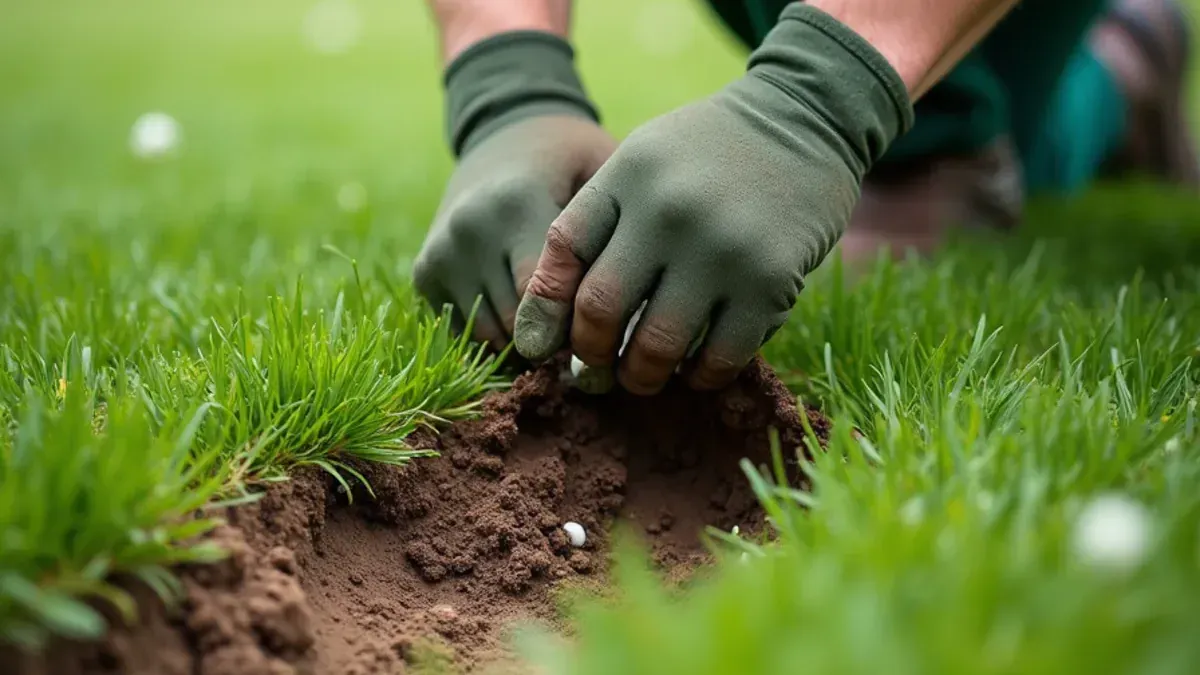
This is the check our crew runs before recommending any curative treatment. It takes ten minutes and a flat spade.
- Pick a spot at the edge of a damaged area, where brown meets green.
- Cut three sides of a 1-foot-by-1-foot square about 2–3 inches deep.
- Fold the flap back like a carpet along the uncut edge.
- Count the grubs in the soil and roots. Check three or four spots across the lawn.
- Press the sod back down and water it; it will reroot.
Purdue guidance puts the treatment threshold at roughly 10 or more grubs per square foot for most home lawns. A well-watered, thick lawn can tolerate a few more; a thin, drought-stressed lawn may show damage with fewer. Finding two or three grubs is normal and does not justify an insecticide.
Preventive vs. Curative Grub Control
Preventive: June through July
Preventive products are applied before eggs hatch and remain in the root zone to kill young grubs as they begin feeding. The two main categories are chlorantraniliprole, which can go down from spring into July and is very low in toxicity to bees, and neonicotinoids such as imidacloprid, applied June to mid-July. Both need about half an inch of water afterward to move them into the soil.
Preventive treatment makes sense for lawns with grub damage in the past two years, or those near heavy Japanese beetle activity. It is not a must for every lawn every year.
Curative: mid-August through September
Once damage shows and counts top the threshold, a fast-acting curative product such as trichlorfon is the right tool. Water the lawn the day before so grubs move up toward the surface, apply, then water in right away. Results drop off sharply by October, when grubs are larger and heading deeper.
At Speedway Lawn Maintenance we apply grub products according to the label and Indiana State Chemist (OISC) rules, and we mow down flowering clover and weeds before any neonicotinoid application to protect pollinators. Grub control fits naturally alongside our weed control service and seasonal fertilization program, since timing is the whole game for all three.
Repairing Grub-Damaged Turf
Grub-killed grass does not come back; the roots are gone. Rake out dead turf, loosen the soil, and seed in the late-August to mid-September window, ideally paired with core aeration and overseeding. Newer subdivisions, like many we service for lawn care in Westfield, often have young, shallow-rooted sod that shows grub damage faster than older lawns. Those yards are good candidates for a preventive plan the following June.
From our crew's experience
What Our Crew Checks Before Recommending Grub Control
Most brown patches we get called about in August are not grubs. On Speedway and west-side Indianapolis lots, the usual suspects are the hot strip along a driveway or sidewalk, dog spots, and a dull mower blade tearing dry turf. So we tug the grass and dig before we recommend anything. If the turf holds, the conversation turns to watering and mowing height instead of insecticide.
Lawns that do get hit tend to follow a pattern. Beetles lay eggs where the soil stays moist in July, so the one watered lawn on a dry street often draws more of them than its neighbors. Thin sod laid over compacted builder fill shows damage first, because it has so little root to lose.
Three mistakes show up again and again: a curative product spread in May, a preventive granule left sitting on the surface without half an inch of water, and preventive treatment every year on a lawn that has never counted more than three grubs. Each one costs money and puts product down with no benefit.
DIY is reasonable on a small lot with no damage history: one chlorantraniliprole application in May or June, watered in, following the label. Call us when damage spreads across several patches, counts top 10 in late August, or dead turf needs reseeding before mid-September.
FAQ
Common Questions
Is milky spore effective on Indiana grubs?
Milky spore has a poor track record in university testing for the grubs that cause most Indiana lawn damage. It targets Japanese beetle larvae only, not masked chafers, and establishes slowly and unevenly in cooler soils. For reliable results, a properly timed preventive or curative product is the better choice.
Can I apply grub control in the spring?
Spring grubs are large, close to pupating and hard to kill, and they rarely cause serious damage before they stop feeding. Curative products applied in April or May usually waste money. Chlorantraniliprole can be applied as early as April, but its job is preventing next summer’s generation, not the grubs present now.
Will grub control stop skunks and raccoons from digging?
It removes the food source, so digging usually tapers off once grubs are gone. It will not stop animals right away, and it will not help if they are hunting earthworms instead. If digging continues after a confirmed low grub count, the animals are likely after worms, which recover quickly.
How soon can kids and pets use the lawn after grub treatment?
The product label sets the re-entry rule, and it varies by product. For most granular grub products, that means waiting until the application has been watered in and the grass has dried. When we treat, we text you the re-entry timing and any watering instructions so nobody has to guess, and we skip play areas you point out.
The Bottom Line
Confirm grubs with a peel test, treat only above roughly 10 per square foot, and match the product to the season: preventive in June and July, curative in mid-August through September. That approach protects your lawn without spraying insecticide it does not need.
If you are seeing brown patches or overnight digging, Speedway Lawn Maintenance can check grub counts and build treatment into your seasonal plan. Text or call 1-323-606-0255 to schedule a visit.